
CHURCH OF THE BRETHREN NETWORK
Continuing the work of Jesus : Peacefully ~ Simply ~ Together
UNOFFICIAL WEBSITE OF THE CHURCH OF THE BRETHREN

|
CHURCH OF THE BRETHREN NETWORK Continuing the work of Jesus : Peacefully ~ Simply ~ Together UNOFFICIAL WEBSITE OF THE CHURCH OF THE BRETHREN |
|
 |
 |
|
The following terms reflect the culture of the Church of the Brethren, a denomination grounded on the principles of Anabaptism and founded through the Pietist efforts of Alexander Mack, in the summer of 1708 near the small German village of Schwarzenau. This resource is not an exhaustive compilation of all denominational terminology, which might also be garnered from other Brethren works, such as the Brethren Encyclopedia, Brethren Bibliography, European Origins, Brethren in America, Ephrata Cloister, 19th Century Acculturation, Brethren Timeline, Brethren Groups, and Brethren Genealogy. You are encouraged to share your comments, suggestions, or corrections with the Web Administrator.
The son of a German miller, born in the town of Schriesheim, Germany, in 1679. This town was in the heart of the Palatinate and experienced the earliest influence of Separatist activity. Records in the local Reformed Church indicate that he was baptized as an infant on July 27, 1679, and later married Anna Margaret Kling on January 18, 1701. Over the years, they had three sons and two daughters: Alexander, John, John Valentine, Christina, and Anna Maria. Mack's father was an elder in the Reformed Church and briefly served as mayor of Schriesheim in 1690 and 1696; and when he died in 1706, the mill was bequeathed to Alexander and his brother John Philip. Alexander was greatly influenced by Pietism and extended a personal invitation to Hochmann to come and minister in Schriesheim, who then used Mack's property for Pietist meetings. Although inconclusive, there is convincing evidence from some historians that Alexander even accompanied Hochmann on several preaching tours. When Pietist activity in Schriesheim became intolerable for local authorities, Hochmann was sentenced to hard labor, the Klings were excommunicated (Mack's in-laws), Alexander and Anna Mack sought refuge at Schwarzenau in the district of Wittgenstein, and many other Palatinates with Pietist leanings were expelled. Feeling secure under the protection of County Henrich Albrecht, Mack sold the remainder of his property in the spring of the following year (1707), and ministered to the needs of other refugees, as well as pay the legal fines of close friends.
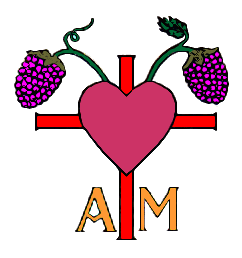 |
| ALEXANDER MACK SEAL |
In the summer of 1708, he contemplated organizing a small community of believers, who would attempt to implement Pietist experiential faith by communal practice, involving believer's baptism, sharing all goods as common, confession of sins, and diligently spending vast amounts of time in prayer in order to advance personal holiness. One mentionable difference existed between Mack and Hochman. The latter being one of the more extreme Separatists in Pietism, he did not believe that an organized church was necessary. Hochmann considered the pure Church to be spiritual, without formal clergy, ritual, the need of sacraments or buildings, whereas Mack held to the former. Living in the company of a few other, like-minded believers they began to evaluate their mutual circumstance, particularly their unbaptized state (having repudiated infant baptism). If spiritual progress was to be made, it would be necessary to resolve these two hindrances through organizing and baptizing themselves.
Mack frequently sought advice from his radical Pietist friend and mentor Ernest Hochmann who was schooled not only in the power of oratory, but also as frequent recipient of the wrath of the authorities. As Mack continued to dream of his own “separatist-communal experiment,” he penned a letter seeking advice, guidance, and prayer from Hochmann, who was then imprisoned at Nurnberg. In Hochmann's reply dated July 24, 1708, he guided the young visionary to ponder carefully the words of Jesus in Luke 14:28 - “count the cost!” A few months later, the twenty-nine year old idealist and seven others went to the Eder river at Schwarzenau and proceeded to inaugurate their group through trine immersion baptism according to their interpretation of Matthew 28:19. Alexander Mack, Jr. later recalled that one person baptized his father who in turn baptized the others. They were five men and three women; Alexander Mack, George Grebi, Lucas Vetter, Andrew Boni, John Kipping, Joanna Kipping (wife of John), Joanna Noethiger, and Anna Mack (wife of Alexander). First known as the Schwarzenau Täufer, they would later adopt the separatist, anabaptist title of German Baptist Brethren. In the quietude of the district of Wittgenstein, Alexander Mack would attempt to institute a spiritual experiment in communal living, vigorously pattern after the New Testament account of early believers. His inherited wealth largely contributed to their ability to live under common ownership, a noteworthy state that later dissolved in almost direct correlation to the expenditure of the wealth. Enjoying a brief respite from persecution, Mack would galvanize his social ideas and theology to practical living, and his writings reflected and defended the Anabaptist Pietist heritage. He traveled extensively into the surrounding country which resulted in congregations at Epstein and Marienborn. The early Brethren message was evangelistic and centered on the simple New Testament teachings of Jesus Christ.
A monthly magazine which serves as the official voice of the Church of the Brethren. It is issued ten times per year with a combined issue in January/February and July/August. For a history behind the development of Brethren publications, see Nineteenth Century Acculturation of the Brethren. This magazine was previously titled the “Gospel Messenger” until January, 1965 when the word Gospel was removed.
An extended ministry of On Earth Peace Assembly which offers conflict resolution guidance to congregations, church camps, and related groups, through programs of training seminars, workshops, and educational materials.
A program of ministry for young adults working under the direction of local congregations.
Created by an official action of Annual Conference 2008 that combined the former General Board with the former Associal of Brethren Caregivers to form a new board whose stated vision is to “wholly engage in the reconciliation of all people to God and to each other”. Their mission is “to extend the church??s witness around the world ... serving as a bridge between the local and global communities by creating opportunities for service and partnership.” MMB serves as a liason to each of the twenty-four districts and facilitates search committees appointed by districts to secure new District Executive/Ministers.
An independent, Brethren affiliated, property and liability carrier offering insurance plans for congregations, agencies, and individuals, that was formed in 1885 by the Northeast District Conference of Kansas.
 |
 |

 Messenger